The Early Foundations of Neural Networks and Perceptrons
A journey through the origins of neural networks, from the McCulloch-Pitts neuron to the Perceptron learning algorithm
Brief History
The story of deep learning began in 1943, when Warren McCulloch and Walter Pitts introduced a mathematical model of a neuron. Their groundbreaking work demonstrated that simple networked units could perform logical computations, laying the foundation for neural computation.
In 1958, Frank Rosenblatt proposed the Perceptron, the first trainable neural network. Unlike earlier models, it could learn from data by automatically adjusting its own weights—a revolutionary capability that marked the birth of machine learning.
This early optimism was abruptly challenged in 1969, when Marvin Minsky and Seymour Papert published their influential book Perceptrons. They rigorously proved that single-layer networks could not solve non-linearly separable problems, most notably the XOR problem. This criticism slowed research significantly and triggered the first AI winter, a period of reduced funding and waning interest in neural networks.
Despite this setback, crucial progress continued beneath the surface. In 1979, Kunihiko Fukushima introduced the Neocognitron, a hierarchical multi-layer model for visual pattern recognition and a direct ancestor of modern convolutional neural networks (CNNs). Around the same time, the mathematical foundation for training deep networks—backpropagation—was being formalized by researchers like Seppo Linnainmaa and Paul Werbos. The breakthrough came in 1986, when David Rumelhart, Geoffrey Hinton, and Ronald Williams published a landmark paper demonstrating how backpropagation could efficiently train multi-layer networks, sparking a resurgence of interest.
The modern deep learning era began in the mid-2000s, driven by three converging factors: massive datasets like ImageNet, improved algorithms, and powerful GPU computing. This convergence culminated spectacularly in 2012 with AlexNet, whose record-shattering performance in the ImageNet competition demonstrated the overwhelming power of deep learning and launched the AI revolution we’re experiencing today.
McCulloch-Pitts Neuron: AI’s First Spark
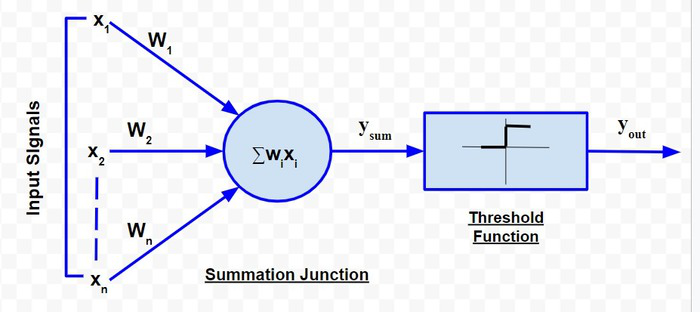 A simple threshold-based neuron model
The McCulloch-Pitts (MP) neuron, introduced in 1943, was the first mathematical model of a biological neuron. It elegantly showed that simple binary computational units could perform complex logical operations when networked together—a profound insight that launched the field of artificial intelligence.
How It Works: Simple Threshold Logic
The MP neuron’s mechanism is remarkably straightforward:
- Inputs are binary values (0 or 1)
- All inputs are summed together
- The sum is compared to a preset threshold (θ)
- Output is 1 if the sum meets or exceeds the threshold, otherwise 0
The model also introduced inhibitory inputs—a powerful concept where a single active inhibitory signal acts as a veto, forcing the neuron’s output to 0 regardless of all other inputs.
Example: Building a Logical AND Gate
We can construct a logical AND gate using an MP neuron with elegant simplicity. With two inputs (x₁, x₂) and a threshold set to 2, the neuron fires only when the sum equals or exceeds 2—which happens exclusively when both x₁ and x₂ are 1. This perfectly replicates the AND function. By adjusting the threshold to 1, we could similarly build an OR gate.
Decision Boundary and Linear Separability
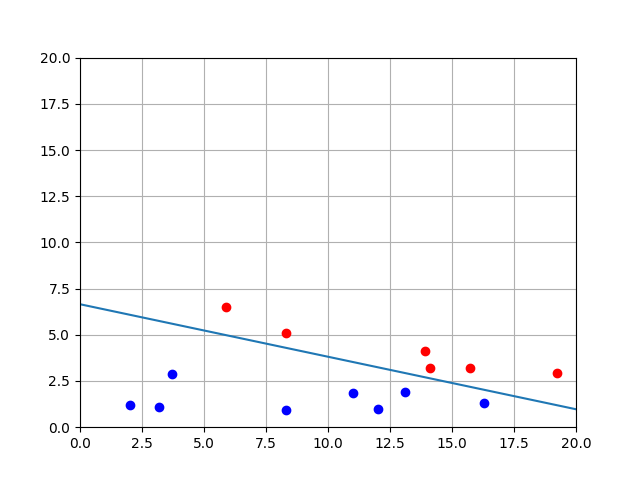 Linear decision boundary created by a single neuron
A single MP neuron creates a linear decision boundary that geometrically divides the input space. For two inputs, this boundary is a straight line defined by the equation ∑xᵢ - θ = 0.
All input combinations that produce an output of 1 lie on one side of this line, while those producing 0 lie on the other. This clean geometric separation leads to a fundamental concept: linear separability.
The Power and Limits of Linear Separability
A single McCulloch-Pitts neuron can represent any boolean function that is linearly separable—meaning a single straight line (or hyperplane in higher dimensions) can cleanly separate the inputs producing ‘1’ from those producing ‘0’.
This elegant simplicity also reveals critical limitations: What about real-valued inputs beyond binary? Could a neuron learn its own optimal threshold? And crucially, how could it solve problems that aren’t linearly separable?
These fundamental questions drove researchers toward the next breakthrough: the Perceptron.
Perceptron: A Neuron That Learns
The Perceptron, introduced in 1958 by psychologist Frank Rosenblatt, represented a quantum leap forward. It addressed the MP neuron’s key limitations through three revolutionary innovations:
- Weighted inputs – each input xᵢ receives a numerical weight wᵢ, signifying its importance in the decision
- Learnable bias – the threshold becomes adjustable, treated as a special weight that can be learned
- Real-valued inputs – no longer limited to binary data, enabling real-world applications
The Perceptron Rule
At its core, the Perceptron extends the MP neuron’s logic by calculating a weighted sum of inputs:
\[y = \begin{cases} 1 & \text{if } \sum_{i=1}^{n} w_i x_i + b \ge 0 \\ 0 & \text{otherwise} \end{cases}\]Here, the bias b (equivalent to -θ) represents the neuron’s prior “tendency” to fire. A high bias makes the neuron more likely to activate, while a low bias makes it more selective.
What Makes It Different?
Like the MP neuron, a single Perceptron still produces only a linear decision boundary, so it can only solve linearly separable problems. So what makes it a revolutionary upgrade?
The answer is learning. In the MP neuron, the threshold and weights were fixed parameters that had to be manually designed. In the Perceptron, these parameters can be automatically learned from data using an elegant learning algorithm.
This ability to learn from examples was a monumental conceptual leap—transforming neural networks from static logical devices into dynamic, adaptive systems.
Perceptron Learning Algorithm
 Weight updates happen only when the model makes a mistake
The Perceptron Learning Algorithm is beautifully intuitive. Its core principle: learn only from mistakes. When a prediction is correct, the weights remain unchanged. When wrong, adjust them to fix the error.
How the Algorithm Works
The algorithm iteratively processes training examples, updating weights only upon misclassification:
For a misclassified positive example (x should be 1, but w·x < 0):
- Update rule: w = w + x
- This nudges the weight vector closer to x, increasing their dot product and making a positive classification more likely next time
For a misclassified negative example (x should be 0, but w·x ≥ 0):
- Update rule: w = w - x
- This pushes w away from x, decreasing their dot product and moving toward the correct negative classification
The process repeats, cycling through the data until every single point is classified correctly—a state called convergence.
The Perceptron Convergence Theorem
This simple algorithm comes with a powerful mathematical guarantee: the Perceptron Convergence Theorem proves that if a dataset is linearly separable, the algorithm will find a solution in a finite number of steps. No matter the starting weights, convergence is guaranteed.
However, this theorem also exposes the model’s fundamental limitation. If the data is not linearly separable—like the infamous XOR problem—the algorithm will never converge. It will loop indefinitely, continuously adjusting weights without ever finding a perfect solution.
This critical limitation became a turning point in AI history. When Minsky and Papert rigorously proved these constraints in 1969, it didn’t just slow research—it catalyzed the eventual development of multi-layer networks and backpropagation, the foundations of modern deep learning.
Why This Matters
The limitations of single-layer perceptrons weren’t failures—they were stepping stones that led directly to:
- Multi-layer neural networks that could solve non-linearly separable problems
- Backpropagation algorithms for training deep architectures
- Modern deep learning systems powering today’s AI revolution
Understanding these foundational concepts is essential for anyone working in AI. The principles pioneered here—weighted inputs, learnable parameters, gradient-based learning, and decision boundaries—remain at the core of even the most sophisticated neural networks today, from transformers to diffusion models.
The McCulloch-Pitts neuron and Perceptron weren’t just historical curiosities. They were the spark that ignited an intellectual fire, demonstrating that machines could learn, adapt, and solve problems in ways that continue to reshape our world.
References
- McCulloch & Pitts (1943): The first mathematical model of a neuron
- Rosenblatt’s Perceptron: A perceiving and recognizing automaton
- The XOR Problem: How a simple logic puzzle exposed early AI’s limits
- Perceptron Learning Algorithm: Mathematical proof of convergence
- Fukushima’s Neocognitron: Original paper (1980)
- Backpropagation (1986): Learning representations by back-propagating errors
- ImageNet: The dataset that changed everything
- DataVersity: A brief history of deep learning